I'm unsure of how long I've been a reader of "MoneyWeek" magazine. I seem to remember I discovered it by mistake when the magazine I was subscribed to at the time went bust. What serendipity!
In the 15 January issue, number 776, there are three nuggets which illustrate why I read this publication:
In "The best blogs" on page 31 are entries from CafeHayek.com and StumblingAndMumbling.typepad.com. The first outlines why capitalism is so great, and outlines why we've "never had it so good". The second says why "there's a long way to go".
I read these one after the other, and it left me thinking.
CafeHayek.com's contention is that "it's hard not to conclude that capitalism is delivering". Granted - mostly, I feel. But it also touches upon the fact that a huge proportion of the world's wealth is in the hands of far less than 1% of the population.
SumblingAndMumbling.typepad.com points out that for most in the west, this wealth comes at the cost of being a wage slave; "...we shouldn't overlook capitalism's inability... to provide higher, non-matierial goods for all - goods such as real freedom, security, self-actualisation and workplace autonomy." That sounds reasonable, too.
BUT -- hang on, isn't the fact that wealth is so skewed, and wage-slavery so prevalent in the west a result of crony capitalism? Isn't this what we really have? True democratic capitalism lifts all boats in a pretty equal fashion, surely?
Then I turned to page 32, where the late and much mourned (by me for sure) David Bowie, who provided a substantial part of the soundtrack to my formative years, is profiled.
Buried in the page is this: "He was subversive because capitalism is subversive, overturning the status quo, restless, and profoundly democratic."
And that, dear reader (if there are any!) is the nub of my thought: allow democratic capitalism to thrive, and we're on to a winner!
Thank you, "MoneyWeek". Please continue to your unbiased account of humanity, which is what the story of wealth accumulation ultimately is all about.


Money: What Is It? What is Interest? What is the Wealth of a Nation?

Angela
Merkel and IMF chief Christine Lagarde can laugh it up as Europe burns
down. The whole crisis stems from antiquated ideas that center on what
money actually is. If you do not grasp what the true function which
money actually provides within the economy, then you will be unable to
get anything else right either. This entire idea of austerity is the
crazy notion that money somehow should be a store of value.
This is up there on the list of myths with those who also argue that
markets decline because of shorts rather than comprehending that
eventually longs do also sell.
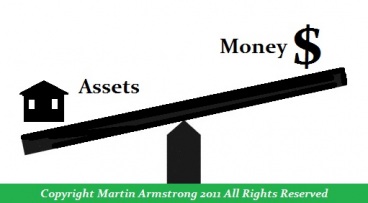
Money is the OPPOSITE of
assets and has always been historically. This is incredible important
to understand far more than you may realize. If you want money to retain
its purchasing power/value, you are creating a false image of how the
economy functions. For Germany to be politically obsessed with the days
of hyperinflation and constantly attempt to impose austerity, they are
adopting the anti-asset position and that is the source of deflation.
Interest
is actually supposed to be a measure of expected inflation and is
essentially dealing in options. Whatever the rate of interest, the
lender is expecting that the money will buy the same amount of assets
upon repayment plus some profit in excess – the interest rate +
inflation. Bankers
want the same purchasing value back upon repayment plus their profit
which is the entire purpose of lending money. Yet historically, the boom
and bust cycle is the rise and fall in the purchasing power of money as
measured in terms of assets. That is what is rising and falling – the
purchasing power of maney against tangible assets/services (labor). When
the purchasing power of money declines and assets rise, we call this a BULL MARKET. When the purchasing power of money rise and assets fall, we call this a BEAR MARKET.
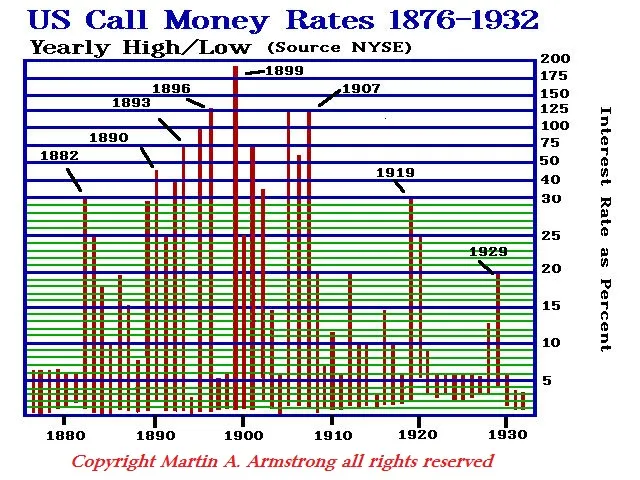
I
have written many times that there is no magic level in interest rates
that will cause the stock market to fall. As a market rises (BULL MARKET), interest rate MUST rise for that is the option on money and its future purchasing power upon return. Thus, it has NEVER BEEN
the direction of interest rates that determines the direction of
assets, for they are historically linked and must be. Only a fool,
indoctrinated by Marxist-Keynesianism, does not grasp that the economy
cannot be manipulated by interest rates. This is why doing empirical
studies of these two factors on a correlation model reveals simply that
the stock market HAS NEVER peaked with the same level
of interest rates twice in history. The level of interest rates is
indistinguishable from a option premium on the future expectation of
that particular asset. Therefore, interest rates are a reflection of
anticipated decline in the purchasing power of money.
 The Federal Reserve keeps talking about the “normalization”
of interest rates. They will not come out and explain what I am
writing right now because it would expose that the emperor is naked. The
Fed sees that negative interest rates proposed by the legendary banking
advocate Larry Summers who may have been an agent from Hell sent to
Earth to wipe out the economy, are highly destructive and amount to a
tax on money. Negative interest rates can only be totally destructive to
all asset classes and furthers deflation to the extreme. People then
would hoard money outside of banks to avoid the tax and this leads
governments on their quest to eliminate physical money and embrace the
age of electronic money. That changes the entire game and embraces
economic totalitarianism.
The Federal Reserve keeps talking about the “normalization”
of interest rates. They will not come out and explain what I am
writing right now because it would expose that the emperor is naked. The
Fed sees that negative interest rates proposed by the legendary banking
advocate Larry Summers who may have been an agent from Hell sent to
Earth to wipe out the economy, are highly destructive and amount to a
tax on money. Negative interest rates can only be totally destructive to
all asset classes and furthers deflation to the extreme. People then
would hoard money outside of banks to avoid the tax and this leads
governments on their quest to eliminate physical money and embrace the
age of electronic money. That changes the entire game and embraces
economic totalitarianism.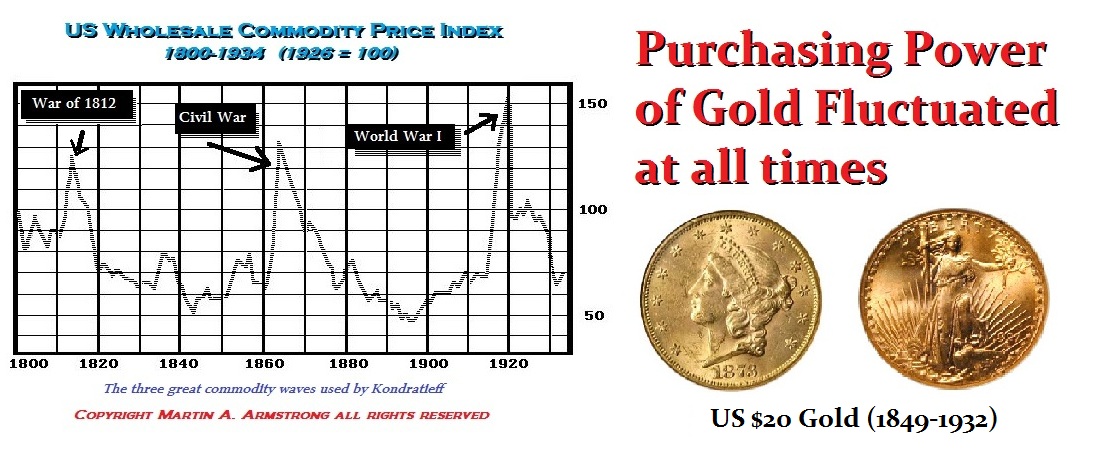
These
people are fundamentally destroying everything because they are
clueless about what is really money. Both China and Japan rose from the
ashes without gold, proving that the wealth of a nation is not its gold
reserves, but the total productive capacity of
its people. Returning to a gold standard will not provide some magical
check and balance where assets still rise in value yet gold/money would
retain its purchasing power. They are totally lost in the rambling of
their own mind. When gold was used as money, it rose and fell just as
anything else that has ever been money proving it does not matter what
you use for money, the same result will always emerge – money is on the
opposite side of money. If you cannot grasp this fundamental
realization, then you are doomed to screwing up the economy and society
big time.
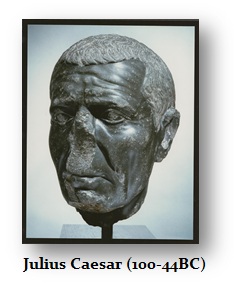 The only politician throughout history who truly understood this fact of life was Julius Caesar.
To solve the debt crisis, he realized that the value of money rose
above what it once had purchased and the price of assets reflected in
terms of money had declined. He realized that when a banker lent you
money to buy a home say $100,000, and the market crashes, a $100,000 can
perhaps buy two houses. The banker then reaps a huge profit demanding
full repayment. Caesar’s solution? He appointed a board to revalue all
assets to the point when the debt was entered. He then attributed all
previous interest payment to reduce that capital borrowing and therein
settled all accounts. Caesar reduced the profits demanded by the bankers
in purchasing power terms. He revitalized the economy and ended the
debt crisis.
The only politician throughout history who truly understood this fact of life was Julius Caesar.
To solve the debt crisis, he realized that the value of money rose
above what it once had purchased and the price of assets reflected in
terms of money had declined. He realized that when a banker lent you
money to buy a home say $100,000, and the market crashes, a $100,000 can
perhaps buy two houses. The banker then reaps a huge profit demanding
full repayment. Caesar’s solution? He appointed a board to revalue all
assets to the point when the debt was entered. He then attributed all
previous interest payment to reduce that capital borrowing and therein
settled all accounts. Caesar reduced the profits demanded by the bankers
in purchasing power terms. He revitalized the economy and ended the
debt crisis.The wealth of a nation is the total productivity of its people. If I have gold and want you to fix my house, I give you the gold for your labor. Thus, your wealth is your labor, and the gold is merely a medium of exchange. So it does not matter whatever the medium of exchange might be. You will give your labor provided you know someone else will accept the medium of exchange from you in purchasing something else. It is the labor of the people and their productive capacity that creates the wealth of any nation. Germany rose from the ashes in Europe to be the strongest economy without gold all on the back of the total productive capacity of its people. The same is true for Japan and for China. Where corruption prevailed as in Russia and they relied upon selling a commodity rather than the productive capacity of its people, then its economy has not soared as did China, Japan, or Germany. This also explains the third world status of South America and Africa. When a country exploits is natural resources to gain wealth rather than educating its people, its long-term viability will diminish with the reduction in the supply of its natural resources or in the case of oil, against rising cheaper alternatives. We do not get this fundamental principle correct, we will destroy our economies with excessive taxation, which in turn, reduces the total productive capacity of its people.
