Hi Sundance
I've noted your pessimism and have held off with my penny-worth. However, if its any comfort, I also confirm that my account, which went live after some paper trading with Z12, has just been treading water since late April.
I expect the reasons are un-knowable, but of course all traders must endure draw-down. The test of them, though, is whether they stay the course, and have bomb-proof faith in what they're doing.
My reading around the topic shows how many really successful traders have endured heavy draw-downs, but survived with good cash and risk management.
The markets are currently all in thrall to what central bankers around the world may or may not do, and that isn't helping. But with Z12 retraining regularly, that should ameliorate the issue. I firmly believe that Z12 will spring back into life over the next 6 to 12 months. I say this because my studies surrounding markets led me to this http://www.economicconfidencemodels.com/ by Martin Armstrong (http://armstrongeconomics.com/). I think the markets are simply going sideways currently. I'm expecting a return to action during or after the Autumn.
I'm considering bringing Z3 on-line also. I understand it is not correlated with Z12, and may therefore smooth things out a little. However, with the bozos in control at the central banks, it may not, as all markets may be currently be in a deathly synchronicity, with cash being the only counter-trend bet!
Wednesday, 10 June 2015
Trading sideways
To a trader on the Zorro (http://zorro-trader.com/) platform:

Thursday, 13 November 2014
Government bonds are the safest investment - or are they?
The finance industry will tell you to lend to the government (i.e., buy and hold bonds) as they are safe, and you'll get a coupon (dividend).
ArmstrongEconomics.com begs to differ. Armstrong says how misunderstood by the public government debt is.
MoneyWeek (7th November 2014), whilst debunking recent UK Government self-righteousness in repaying some World War I bonds, points out that wrapped up in this debt is "the capital stock of the South Sea Company, which had so infamously collapsed in 1720."
The article then goes on to detail just what a bad investment these bonds were:
Perhaps the government should have been more honest, and instead of issuing war bonds with a promise to pay interest, it should simply have asked for donations. But... when was the last time anyone heard of a government being honest when it comes to cash? Even a Churchillian one?
The dots are all there. You just need to join them up, and the picture will become crystal clear.
ArmstrongEconomics.com begs to differ. Armstrong says how misunderstood by the public government debt is.
MoneyWeek (7th November 2014), whilst debunking recent UK Government self-righteousness in repaying some World War I bonds, points out that wrapped up in this debt is "the capital stock of the South Sea Company, which had so infamously collapsed in 1720."
The article then goes on to detail just what a bad investment these bonds were:
Not a good investment, then?
No – a terrible one. According to figures calculated for the FT by James Mackintosh, the average rate of price inflation since 1927 has been 4.77% – far in excess of the 4% coupon. In other words, investors who lent Churchill the original £218m in 1927 (when he was Chancellor of the Exchequer) have lost money in real terms – and not just a bit of it. In real terms, HM Treasury sold its Consols (bonds) for £100 each, and is buying them back for (the equivalent of) £1.82 each. To emphasise the apparent boost to today’s taxpayer, the Treasury last week trumpeted its calculation that “the nation has paid £1.26bn in total interest on these bonds since 1927”. In reality, however, the 'nation’ has had by far the better side of the bargain and buy-and-hold investors have seen their capital all but disappear.
Although traders can make money trading bonds in the short term, the buy-and-hold retail investor (what the Americans call "Mom and Pop") is stiffed - and all with the connivance of the investment industry![The italics above are mine.]
Perhaps the government should have been more honest, and instead of issuing war bonds with a promise to pay interest, it should simply have asked for donations. But... when was the last time anyone heard of a government being honest when it comes to cash? Even a Churchillian one?
The dots are all there. You just need to join them up, and the picture will become crystal clear.
How to kick the poor when they are down
Apparently, "posh greens are hurting the poor".
Matt Ridley from The Times is quoted in MoneyWeek, viz:
Very easy to have an environmental conscience when you have a full wallet and are well fed.
Matt Ridley from The Times is quoted in MoneyWeek, viz:
Are today’s greens – typically younger, posher, more female andHere, here!
better-educated than the average voter – really as selfless as they make out? asks Matt Ridley. “Cutting through the spin” of the latest IPCC report, the likely outcome is that the world will be 0.8-1.2 degrees warmer by 2100. By then, the OECD estimates the average person will be earning 300%-600% more in real terms, “enabling posterity to buy quite a bit of protection”. Yet to prevent possible harm to wealthy people in the future, we support policies that fall heavily on today’s poor. “Subsidies for renewable energy have been trousered mostly by the rich and raised costs of heating and transport disproportionately for the poor.” Biofuel use has raised food prices, killing about 190,000 people a year. Most conservationists now recognise that “sustainable intensification”, which uses as little land as possible for crops and energy, is a “key ingredient of environmental protection”. Yes go organic, but “don’t pretend there’s anything morally superior about it”.
Very easy to have an environmental conscience when you have a full wallet and are well fed.
Tuesday, 4 November 2014
REV Trader Pro - Should it stay or should it go now?
REV Trader Pro
Should it stay or should it go now?
With apologies to The Clash and their 1982 song, Should I stay or Should I go now.
- Introduciton
- Balance results
- Monte Carlo results
- Minimum number of trades simulation
- Minimum deposit simulation
- Profit factor
- Sharpe ratio
- GBPUSD with Money Management
- Conclusion
- Further edits
1. Introduction
REV Trader Pro is an EA that works on MetaTrader 4. It is the first EA I have purchased for MetaTrader.
I have been evaluating it over the last week, and am typing up my conclusions here as a method of crystallising my own thoughts as to whether I wish to trade with it or not. If my thoughts are of use to anyone else, then that's good too!
The first thing to note about REV Trader Pro is that its very difficult to do a long term back test on it. Indeed at the time of purchase, the author hadn't provided any. His reply to my enquiry why was that, "Because i'm showing live results, back tests are pretty much the same if you run it." (Sic.)
His live results from December 2013 till now may be found here, at myfxbook.com. Currently they look like this:
 |
| Image taken from myfxbook.com |
As I alluded above, back testing is an issue. To run one for the period January to October 2014 on GBPUSD took 15 hours. Given that I wished to back test all of the four pairs REV Trader Pro trades from 1993 till now, I reckoned that would take minimally 1635 hours, or at least two and a quarter months.
Clearly this wasn't a good idea, not least as that exceeds the refund policy period, but also that I need my computer during that time!
Then I found a post by Antny on myfxbook.com in which he said that he'd achieved a reasonable back test using the "Control Points" method, rather than the "Every tick" one in MetaTrader back tester. He further stated that he'd "noticed there was virtually zero difference in the resultant trades." He also helpfully provided some charts, which at the time of writing are still available on myfxbook.com.
Therefore, using data from AlpariUK, I ran a test to compare January to October 2014 GBPUSD on both methods. I chose GBPUSD as it seemed to give the best chance of a profitable result, as reported by Batchboy here - myfxbook.com:
 |
| Jan to Oct 2014, every tick model |
 |
| Jan to Oct 2014, control points model |
2. Balance results
I therefore ran individual back tests on the four currency pairs REV Trader Pro is designed to work on, AUDUSD, EURUSD, GBPUSD, and NZDUSD. I utilised the standard inputs, as provided by REV Trader Pro in the ".set" files for each pair, with only one change: ECNMode=false. This is because the Alpari account I'm using is a spread bet one, and is not an ECN brokerage account. These used a fixed 0.5 lot trade. Using a low fixed lot is generally a good idea in back tests, as anything else can hide dangerous flaws.
I then combined and analysed the results using MTReport 4.0. At a cost $15, this is a tool all traders should have in their box. For detailed explanations of the charts and tests MTReport generates, see their manual, which you can download without charge here.
The following chart shows the combined results of all four of the currency pairs over the 21.5 year period:
 |
| Balance summary 1993 to date, AUDUSD, EURUSD, GBPUSD NZDUSD date intervals approximate |
Where the line turns red indicates where the points of maximum relative draw-down have occurred. Therefore, in the chart above, this is between the two red lines.
This chart begs the question, why the massive 40% down period? If you'd been trading this over that time, you'd have considered the EA to be broken, or the markets to have evolved - again! It would be safe to predict you would not have started using this EA again now.
It also seems to show that the authors of REV Trader Pro got lucky. They started their live results test right at the time the down period ended, when a major upturn seems to be in place.
This doesn't look like real consistency. How would we know if we were in an extended draw-down period, or just a blip?
The next four charts show the results for the individual currency pairs:
 |
| Balance summary 1993 to date, AUDUSD date intervals approximate |
 |
| Balance summary 1993 to date, EURUSD date intervals approximate |
 |
| Balance summary 1993 to date, GBPUSD date intervals approximate |
 |
| Balance summary 1993 to date, NZDUSD date intervals approximate |
These four charts tell different stories, with some commonality:
- broadly, the balance in all four has been increasing in 2014, coinciding with the test period published by the authors;
- AUDUSD and EURUSD have been largely sideways trading over the 21 years;
- NZDUSD has been a loss for fourteen of the the last 21 years;
- GBPUSD has been the only consistent winner, with only a minor balance down-trend in 1995, when it made its maximum relative draw-down.
3. Monte Carlo results
 |
| Monte Carlo simulation AUDUSD, EURUSD, GBPUSD NZDUSD |
- Perfect - in only 11.2% of the simulated outcomes does the balance remain above the initial deposit;
- Error rate - 1.2% is low, since the simulations were based on 5000 days;
- Risk of ruin - there is an 80.7% risk of incurring 15% draw-down;
- Draw-down - 15.1% is the average draw-down;
- Deviation - a measure of the distance between the maximum and minimum balance for all trades, 124.5%;
- Profit/trade - the calculated average profit per trade;
- Balance - the average ending balance of all the simulation runs, £2478;
- Return - the average return percentage for all simulation runs, 147.8%.
 |
| Monte Carlo simulation GBPUSD |
 |
| Monte Carlo simulation GBPUSD |
4. Minimum number of trades simulation
This MTReport tool indicates the minimum number of trades needed before the return will exceed the draw-down experienced:
- GBPUSD = 1
- NZDUSD = 13
- EURUSD = ~ (stopped after 320, which could equate to around 3.8 years)
- AUDUSD (failed to provide any data - average profit from trade is negative)
5. Minimum deposit simulation
This MTReport tool indicates the minimum deposit you'd need to maintain in an account to safely trade REV Trader Pro against each of the four currency pairs:
- GBPUSD min. deposit =624
- NZDUSD min. deposit = 8226
- EURUSD min. deposit = 9053
- AUDUSD (failed to provide any data - average profit from trade is negative)
6. Profit factor
Profit factor = gross profit / gross loss:
- GBPUSD
- Gross profit = 25257.03
- Gross loss = 17687.91
- Profit factor = 1.43
- AUDUSD
- Gross profit = 9658.94
- Gross loss = 10519.23
- Profit factor = 0.92
- EURUSD
- Gross profit = 22976.81
- Gross loss = 22908.66
- Profit factor =1.00
- NZDUSD
- Gross profit = 17804.82
- Gross loss = 17220.43
- Profit factor =1.03
7. Sharpe ratio

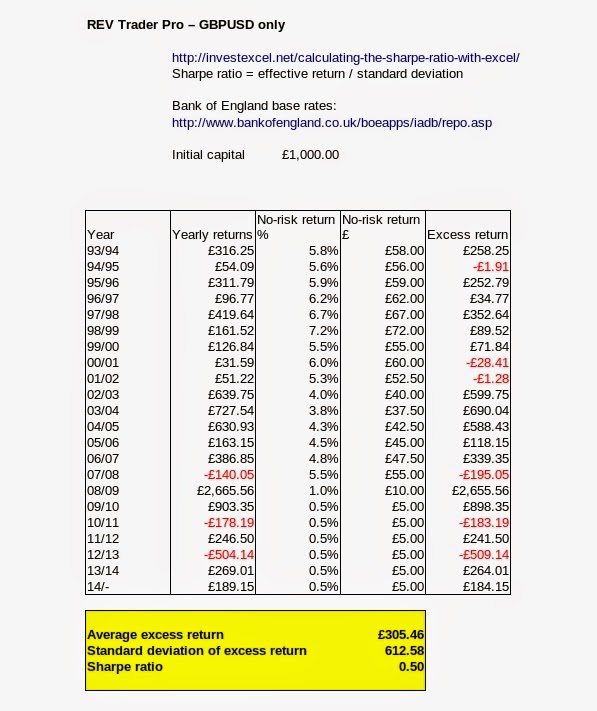
No surprise that the Sharpe ratio for GBPUSD by itself is better than all four pairs traded. A Sharpe ratio of nearer 1 is always the goal.
8. GBPUSD with Money Management
Trading GBPUSD only, and using the Control Points model, risking 3% per trade.
 |
| Jan to Oct 2014 data - Balance, GBPUSD only |
 |
| Jan to Oct 2014 data - Monte Carlo simulation, GBPUSD only |
The minimum deposit to maintain in an account to safely trade GBPUSD reduces to 551.
Profit factor using this profile is now 1.58.
Sharpe ratio = 0.32.
9. Conclusion
REV Trader Pro seems to promise a lot. But I'm not convinced of its longer term delivery.
When trading a system I would expect it to be robust over the long term. How does one discern between a permanent or long-term breakdown of performance and short-term draw-down? I don't think REV Trader Pro has proven its case here.
In addition, I don't understand the inclusion of AUDUSD, EURUSD, and NZDUSD. Yes, they seem to be in a short-term up-trend, but if my history data is correct, that will end sometime soon.
REV Trader Pro seems to be one of the more expensive EAs to buy. I'm not convinced it will meet expectation.
Even increasing the initial deposit from 1000 to 5000, and trading 3% risk in the money management section of the EA, there is no marked improvement in performance:
 |
| REV Trader Pro, Jan to Oct 2014, GBPUSD only, 3% risk in money management |
I'm going to ask for a refund under the 60 day guarantee.
Then I'm going to see if I can design a GBPUSD EA myself using the excellent fxDreema. Highly recommended. A non-programmer's delight, well worth the $95 annually. There are shorter periods too, e.g., monthly at $19, or free for an unlimited reduced functionality trial - and no, I don't get a commission!

I consider this the best of its kind on the market. If you are serious about trading, get your hands dirty without actually having to fully understand MQL4/5.
10. Further edits
4 Nov 2014, 18:14 GMTUseful feedback from John on eareview.net suggested I'd missed something:
John
...have you ever considered that the vendor optimizes it every year? Your using settings, that you hope will work for 20 years, is kind of naive and ridiculous. The markets always change and REV Trader PRO is clearly designed for the recent market of about past 2 years maybe longer. And I”m sure the vendor will provide updates further along.
Me
Yes. True, and I should have said that. I’d rather rely on me being around for 20 years to optimise my own EA, than relying on someone else. After all, the vendor’s interest in me only extends to the initial sale.There again, the vendor’s current setting for GBPUSD *have* lasted for 20 years, and it is the GBPUSD pair that REV Trader Pro seems to rely on for profits!So, with due respect to you, I think I’ll keep to my opinion. But thank you for the comment. I’m going to include it in my text.
Tuesday, 30 September 2014
...for whom the bell tolls...
No man is an Iland, intire of it selfe; every man is a peece of the Continent, a part of the maine; if a Clod bee washed away by the Sea, Europe is the lesse, as well as if a Promontorie were, as well as if a Mannor of thy friends or of thine owne were; any mans death diminishes me, because I am involved in Mankinde;
And therefore never send to know for whom the bell tolls; It tolls for thee.
John Donne, Meditation XVII, 1624

They say that no-one rings a bell at market tops or bottoms. I'm beginning to think that this may not be completely accurate.
That said, my white crash-alert flag of surrender is well and truly tattered. Its been buffeted and trampled on so firmly by a huge bull run, that I've been tempted to take it down, and admit I was wrong.
But then along comes Alibaba. My saviour!
Shares in Alibaba rose 36% on the first day of trading; therefore its P/E is 61. And lest we forget, those shares are not really holdings in the underlying company, but are actually holdings in a "variable interest entity". Understand that? Nor me! But basically, the Chinese government has disallowed overseas shareholders from holding proper shares. To cap it all, governance has been questionable, with Jack Ma, Alibaba's founder, allegedly pulling a fast one in 2010 with Alipay.
Have we entered the "irrational exuberance" stage of the bull? Maybe. When the retail investor starts piling in we'll know for sure. Whether this is the start point, only hindsight will tell. An investor has three options, go long (buy), go short (sell), be out (sit in cash or near-cash holdings).
I'm keeping the latter topped up. What goes up, also comes down. When it comes down, that's when opportunities present themselves.
Wednesday, 24 September 2014
Was Scotland's independence referendum rigged?
Well, was it?
Was Scotland's independence referendum rigged? I dunno. And I dare say never shall.
But I observe the following:
But let's not forget, as I said before, the SNP are socialists, and socialism doesn't work. Whatever you think of Alex Salmond, what he said when he announced his resignation is right; now is the time to make the Westminster politicians stick to their promises made just before the 18th of September. Maybe, just maybe Scotland can progress towards its own brand of capitalism, reduce socialism, all without secession and the inevitable medium term turbulence and bust that that would have condemned its people to endure.
I was struck by what a nineteen year old apprentice welder working in Dundee, earning not much more than the minimum wage, told his Mum before he voted: "Why would I want to swap a stuck-up politician from London with one from Edinburgh? There must be a better way - I'm voting 'no'."
Enough said.
Was Scotland's independence referendum rigged? I dunno. And I dare say never shall.
But I observe the following:
- In order to create a 10% majority in an 85% turnout, there must have been one heck of a lot of rigging, and that wouldn't have been easy to cover up.
- Conspiracy theorists always abound. However, the "evidence" that seems to be circulating, including video, seems to merely highlight incompetence and minor cock-up rather than conspiracy. I don't suppose there has been a flawless count in the history of elections, anywhere.
But let's not forget, as I said before, the SNP are socialists, and socialism doesn't work. Whatever you think of Alex Salmond, what he said when he announced his resignation is right; now is the time to make the Westminster politicians stick to their promises made just before the 18th of September. Maybe, just maybe Scotland can progress towards its own brand of capitalism, reduce socialism, all without secession and the inevitable medium term turbulence and bust that that would have condemned its people to endure.
I was struck by what a nineteen year old apprentice welder working in Dundee, earning not much more than the minimum wage, told his Mum before he voted: "Why would I want to swap a stuck-up politician from London with one from Edinburgh? There must be a better way - I'm voting 'no'."
Enough said.
Friday, 19 September 2014
Scotland's indepencence vote - a civil "war"
I voted "no" to independence yesterday, 18th September. But not
because I don't think Scotland could be independent. Here's why:
I've said it again and again over the last few years: There is no reason why Scotland should not be independent. There are plenty of examples worldwide of small and prosperous nations - Switzerland, Singapore to name but two. But the Scottish Nationalist Party is socialist; indeed, I believe it harbours communists. One of its most famous communists was the poet Hugh MacDiarmid who wrote some wonderful poetry in the Scots language (not Gaelic), and I believe quite a number of the Scottish Nationalist Party (SNP) have quietly continued to adhere to his views.
I know of no instance of a socialist society that has also been prosperous in the long term. Arguably the greatest thinker and economist of any time from any part of the world, a Scot, Adam Smith, born in Kirkcaldy, lived Edinburgh, said that profitable societies work due to the "invisible hand" of commerce being allowed to operate freely. In a nutshell, we all do what we need and want to do, and by and by everything humanity needs and desires is produced, developed, designed, implemented. This is Capitalism. It seems to me that this is largely how the USA worked up till the turn in the 1990's, with a few hiccups along the way. Its what made her a superpower.
Socialists, on the other hand, meddle, fudge, build ever bigger government (the US is now in a socialist trend - Obamacare, for example), get into more and more debt, build ever bigger government to hunt down ever more money to pay for their experiments - a vicious circle. It doesn't work. The Englishman, Thomas Paine, probably the most enlightened revolutionary who ever lived said, "Society in every state (of being) is a blessing, but government even in its best state is but a necessary evil; in its worst state an intolerable one...". With his support and writings, George Washington roused and inspired a rabble of cold, wet and hungry farmers to stand up to the biggest empire the world had known up to that time, and kick it out! Good riddance! Paine was and is right!
I voted against the intolerable evil of big, socialist government - not against the idea of independence per se.
So why do I say that Scotland is now in a civil "war"? Simply this; nearly half of the population seems to want one thing (55%), the other half the opposite (45%). Or that's what they think. I really don't believe most Scots have drawn the distinction I have between Socialism and bigger government on the one hand, and prosperity with independence on the other. There will be a price to pay for this, and Alex Salmond and the SNP will be blamed by history for the troubles to come. However, the SNP is really only symptomatic of a greater trend; the loss of confidence in governments across much of the world, and the backlash against the corruptness of it all.
There will be a reckoning. Investors will struggle to find safety for capital, let alone a return. The situation will only favour traders, but a good many of them will loose their shirts, too.
Can I take heart from the fact that the overall turnout to vote was a staggeringly high 85%? Are Scots democrats? Or, as some commentators have said, did they really just vote for their pensions and self-interest? I really don't know, but they couldn't be blamed for it. But I do know that how it plays out won't be predictable or especially pleasant.
How depressing.
Subscribe to:
Posts (Atom)